
Waze Live Traffic for TV
Mobile web app - 2025

As Waze phased out its legacy tool, we risked losing daily TV exposure across major news networks. Waze needed a fast, scalable way to keep traffic on-air. I led the design of a new broadcast mode making real-time traffic clear, legible and TV-ready.
From deprecation to opportunity
When Waze deprecated its iOS-based Waze on Air app, we risked losing a powerful distribution channel: national TV. In Brazil alone, top broadcasters like Globo used our traffic maps live on-air offering daily reach in the millions.
Waze PartnerHub, our internal tool for traffic visualization, was never meant for broadcast. But time was tight. Instead of launching something new, we aimed to evolve what we had fast.

“...how might we evolve Waze’s PartnerHub into a broadcast-ready platform for live TV, trusted by reporters, seen by millions?”
Listening to the studio people
To understand TV broadcast needs, we spoke directly with producers and traffic reporters from major stations. Their asks were clear: less noise, more clarity. On-screen complexity made it hard to narrate live.
They didn’t need every traffic pin, just the worst jams and tracked routes, visible at a glance. They also wanted fewer colors, cleaner roads, and a map that looked and felt like the Waze app — only simpler.
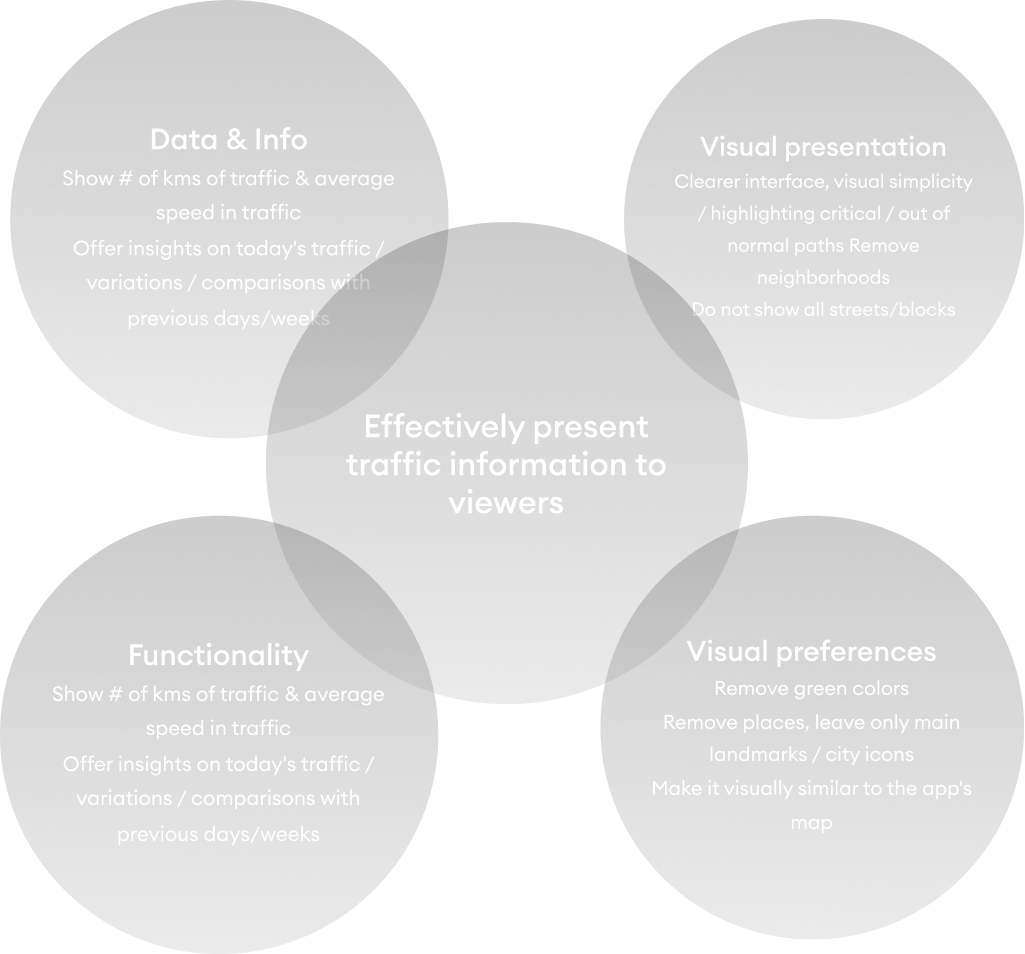
Designing with constraints
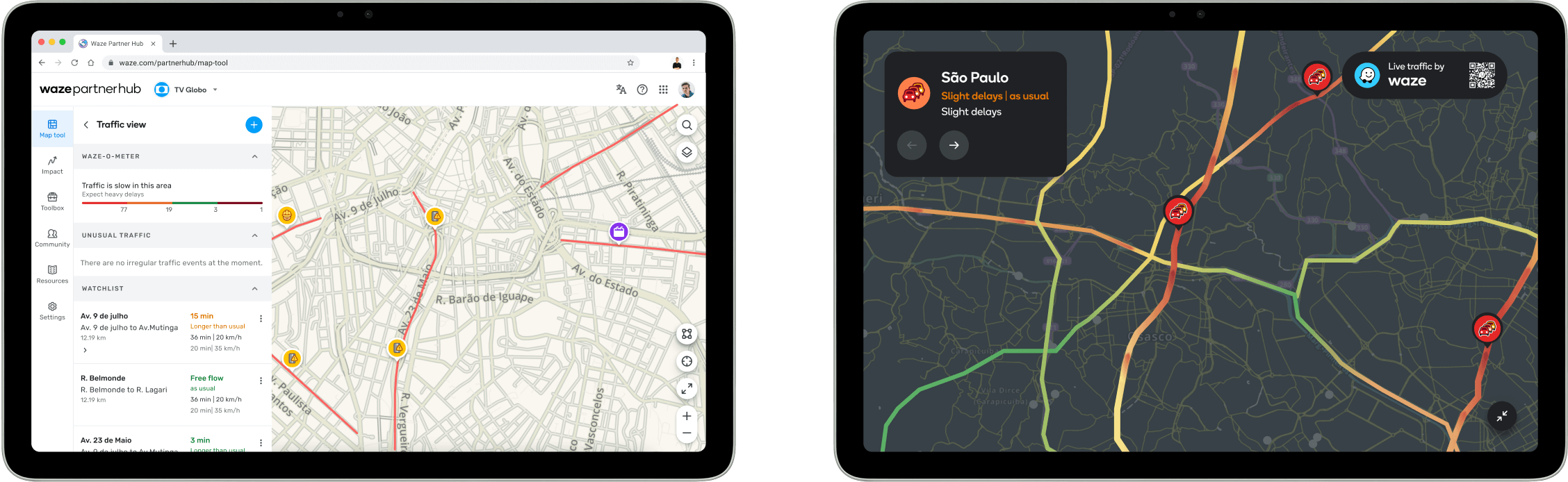
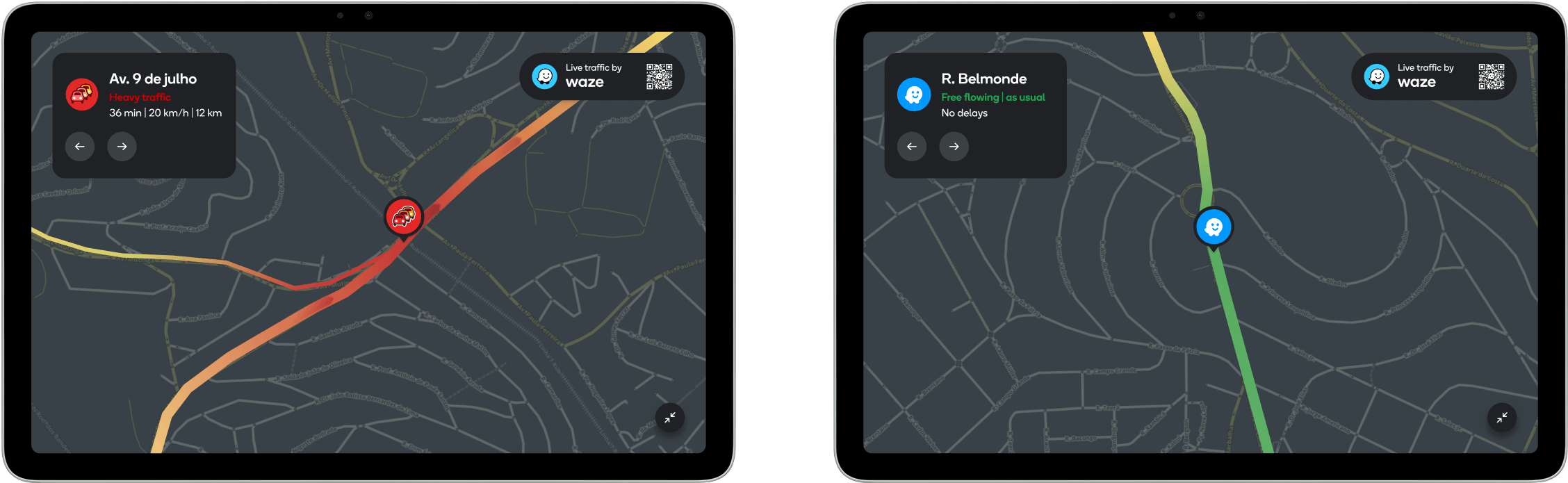
I led the design of a new presentation mode within PartnerHub’s Traffic View reshaping the interface to surface only the most critical traffic info. Non-essential UI elements were intentionally deprioritized to reduce cognitive load and ensure uninterrupted, full-screen legibility. Each jam interaction revealed key data like speed, length, and delay, with automatic centering to support on-air clarity.
A branded Waze logo and scannable QR code were added to support live app engagement on TV. Behind the scenes, I scoped the solution to run on a gated URL with feature flags, enabling quick rollout to trusted partners without introducing new product surfaces. The result was a lightweight broadcast layer purpose-built for clarity, speed, and on-air confidence.
Simulating the studio
To stress-test the visual density of our design, I projected the prototype onto a wall at 1:1 scale mimicking how the UI would appear on air in a live broadcast setting. This allowed me to evaluate legibility from a real viewing distance and identify where map clutter or label overlap could undermine clarity.
Seeing it “on screen” revealed small issues that weren’t obvious in Figma — like icon contrast, QR size, and color dominance and helped us refine the layout for true on-air performance.
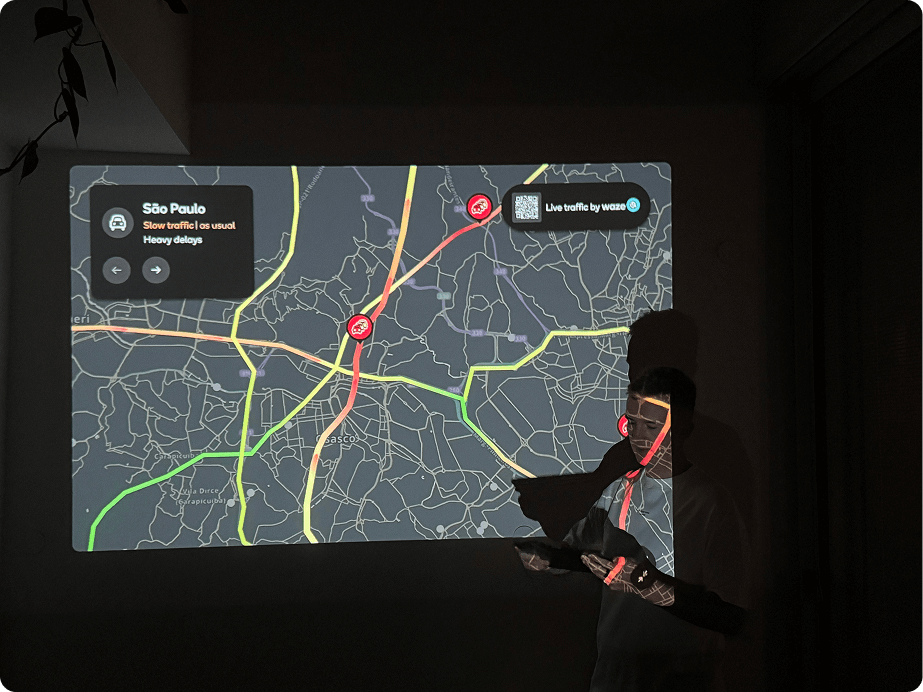
Viewing distance: ~ 1.8m from the object, projection: ~1.04m x 1.63m
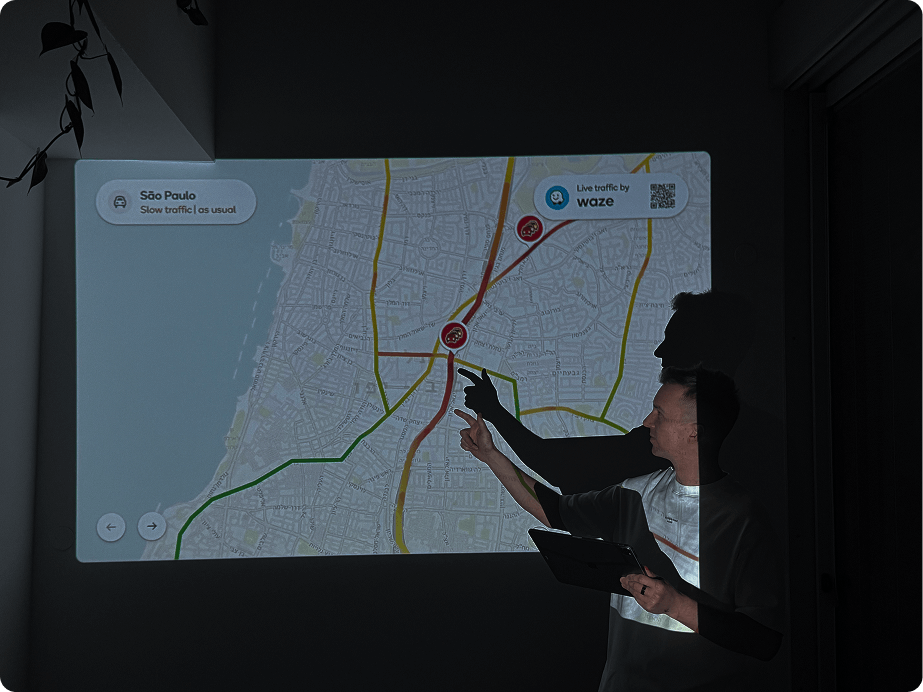
Projection test using prototype to validate on-air readability
Scaling visibility, preserving trust
In just under 3 weeks of engineering effort, we turned a product sunset into a platform upgrade delivering a streamlined, globally-scalable presentation mode that retained key partners and protected Waze’s daily brand exposure.
The final solution was used on air by multiple broadcasters in South America, with zero onboarding or training. It also laid the groundwork for future expansion to other countries and use cases from news to emergency traffic reporting.
Live news broadcast demo of Waze on Air for traffic reporting
Let's make products feel more alive. Say hi.